
Decision fatigue
2 min read · January 23, 2025
New Power Labs
An overlooked driver of inequity is decision fatigue.
Research by Danziger et al. (2011) shows judges’ parole decisions varied throughout the day.
Early in a decision block, judges approve parole about 60-70% of the time. As session progresses, approval rates steadily fall, sometimes to near zero.
After a break for food or rest, approval rates jump back up immediately.
As the same legal standards apply to every case, the order in which cases are heard should not matter. Yet, outcomes appear to be influenced by fatigue, hunger, and cognitive depletion, not just facts or law.
As decision-makers get fatigued, they default to safer, more conservative choices. Two identical cases can receive different outcomes based solely on timing, not merit.
Equity does not always fail because people do not care. It often fails because our systems overlook a reality: even experts are not immune to the influence of irrelevant external factors on their decision-making.
Judges’ Parole Decisions
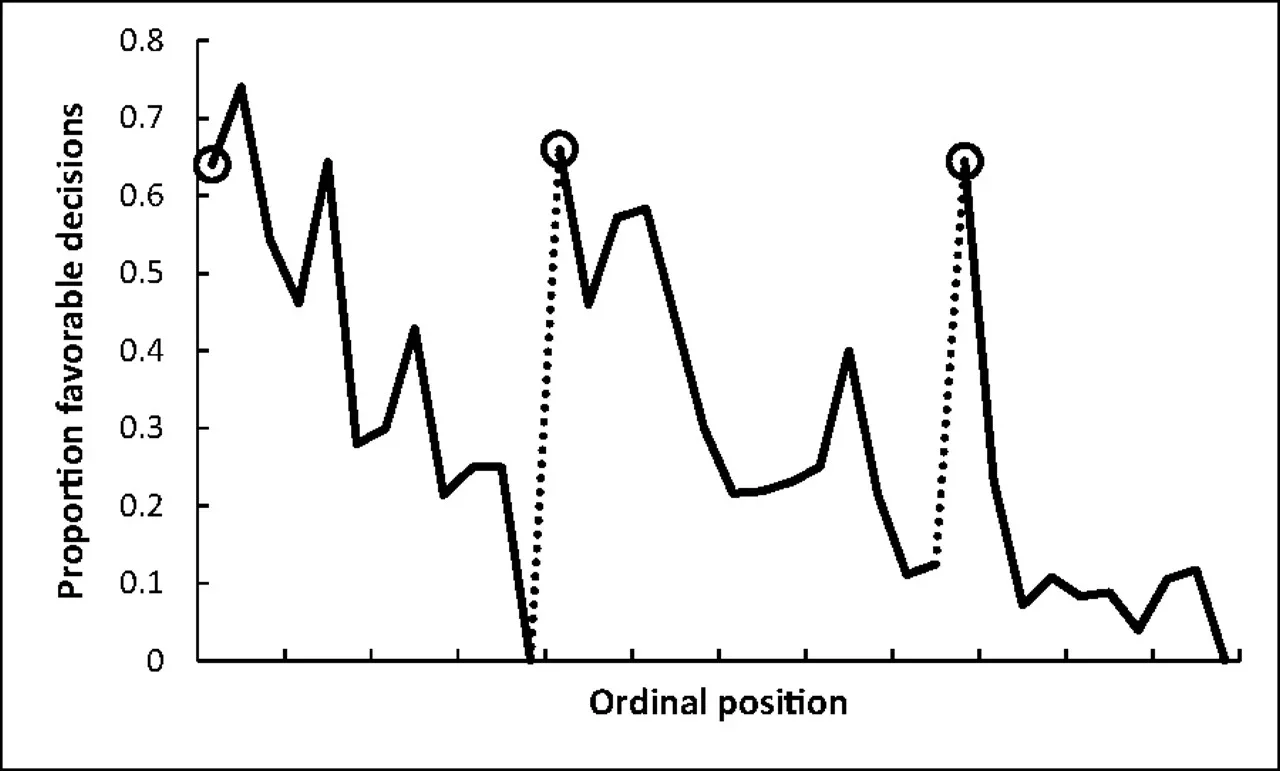
Proportion of rulings in favor of the prisoners by ordinal position. Circled points indicate the first decision in each of the three decision sessions; tick marks on x axis denote every third case; dotted line denotes food break. Because unequal session lengths resulted in a low number of cases for some of the later ordinal positions, the graph is based on the first 95% of the data from each session.
Danziger, S., Levav, J., & Avnaim-Pesso, L. (2011). Extraneous factors in judicial decisions. Proceedings of the National Academy of Sciences of the United States of America, 108(17), 6889–6892. https://doi.org/10.1073/pnas.1018033108
Narinder
New Power Labs
Like what you’re reading? Subscribe to get weekly Equity Shots in your inbox.
